Joint EASAC–FEAM report · Published 30 September 2026
AI in European Healthcare: Policy Recommendations for Optimising Added Value and Safe, Ethical, and Inclusive Adoption
FEAM and the European Academies’ Science Advisory Council (EASAC) set out how AI-enabled health products and services can be evaluated, deployed and governed so that they deliver real benefit to patients and health systems across Europe.
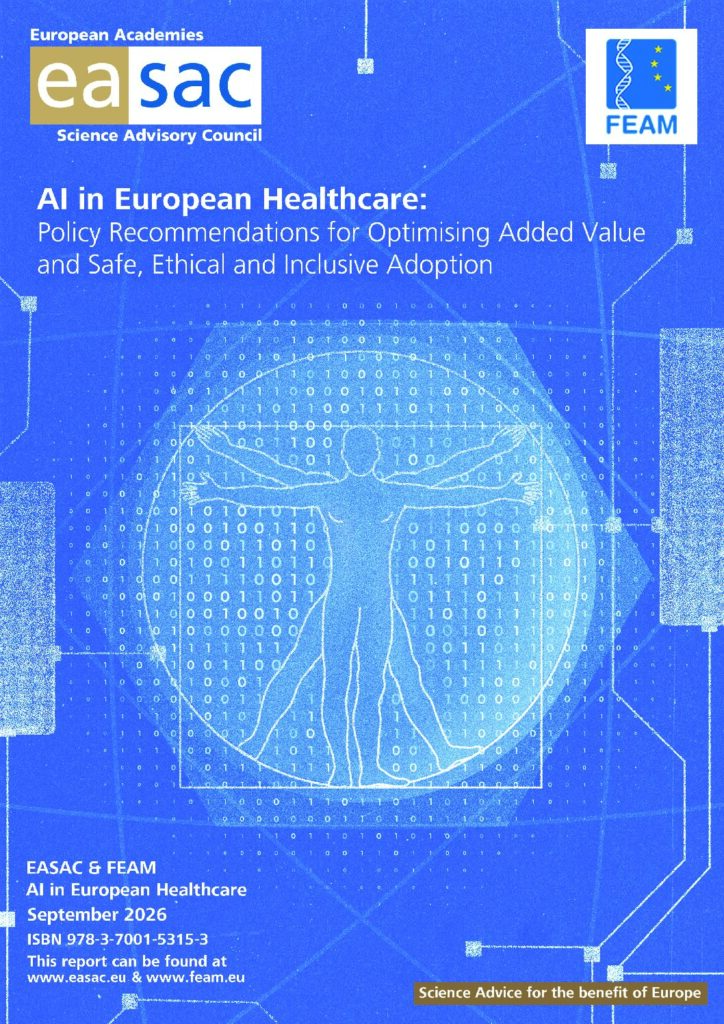
Cite as: doi.org/10.1553/EASAC-FEAM_Report_AI-in-Healthcare_2026. Documents are hosted by EASAC.
AI in healthcare should be held to the same standard as any other medical intervention: its benefits must be demonstrated, its risks understood and its performance monitored continuously. Technical accuracy alone is not enough to benefit patients; it has to be matched by clinical value, judgement and insight.
The report examines the risks that come with rapid adoption, including data breaches, algorithmic bias, loss of human control and dependence on individual technology providers. It is intended to inform implementation of the EU AI Act and the European Health Data Space, as well as forthcoming EU initiatives on AI in healthcare. It makes three calls to policymakers:
Anticipate long-term effects and embed responsibility before deployment.
Prioritise equitable access, transparency, participation and sovereignty.
Harmonise standards, enable interoperable cross-border data use and strengthen collaborative oversight.
Launch event · Brussels · 30 September 2026
The report was launched in Brussels with two panels bringing together the European Commission, hospitals, patients and working group members. Read the summary of the discussions and see the photos.
Video message
FEAM and EASAC have worked together since 2024 to examine how AI-incorporated health products and services can be evaluated for adoption into healthcare use. Key areas of exploration included evidence measurement, randomised clinical trials (RCTs) and health systems research, with use-cases illustrating the added value of AI.
The project assessed the need for new guidance or regulation in light of existing frameworks, including the revised EU regulations on medical devices, the AI framework, the European Health Data Space and the Product Liability Directive. It also addressed barriers to data federation and interoperability across healthcare systems, and ethical considerations such as data protection, privacy, transparency, public trust and equity in health access, with particular attention to consent governance and model explainability. Education and capacity building run through the work, stressing the need to upskill the wider workforce in digital awareness and to integrate these skills into early education.
The joint scoping paper was finalised in January 2023 and presented at a FEAM Forum conference in Sweden in May 2023, co-organised by FEAM under the auspices of the Swedish Presidency of the Council of the EU, with interventions from the European Parliament rapporteur for the European Health Data Space, the DG SANTE legal lead on AI, and members of the Swedish Parliament and Health Authority.
On the FEAM side, the project was overseen by Prof. Luis Martí-Bonmatí with the support of Louise Abboud.
Contact. For any inquiries, please contact FEAM Executive Director Louise Abboud or EASAC Biosciences and Public Health Programme Director Tom Cole-Hunter.